

The Navigator's Advantage: Flexibility as an Asset in Maritime Energy Markets
Reflections from the CEMA Conference in Paris on LNG, Oil Markets, and the Economics of Optionality

Last week, I had the pleasure of presenting at the Commodity & Energy Markets Association (CEMA) conference in Cergy (Paris). My paper, Maritime Energy Dispatch under Market Volatility and Geopolitical Risk: A Multistage Stochastic Optimization Framework, asks a deceptively simple question:
How should energy cargoes be managed when prices, freight rates, congestion, and geopolitical risks evolve continuously over time?
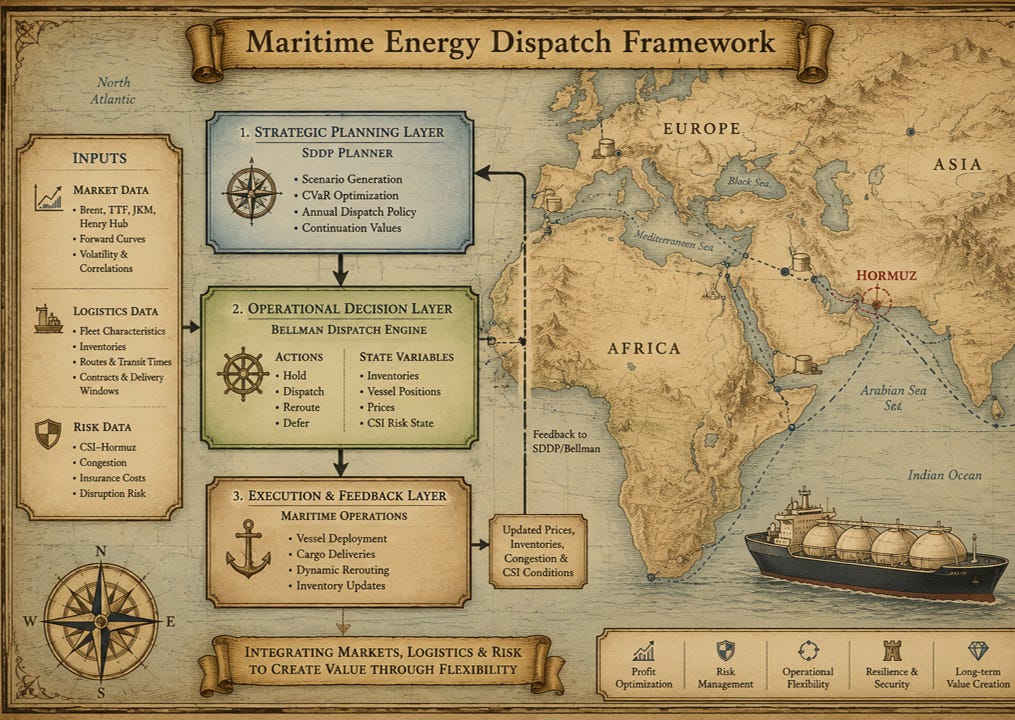
For liquefied natural gas (LNG) and crude oil, transportation is no longer merely a logistics problem. Cargoes can be redirected, inventories can be held, vessels can be delayed, and destination choices can change as market conditions evolve. These decisions are sequential, uncertain, and increasingly intertwined with geopolitical developments.
The framework presented at CEMA combines a 365-day Stochastic Dual Dynamic Programming (SDDP) planning layer with a Bellman/MILP dispatch engine. Together, these allow long-term policy guidance and short-term operational decisions to interact within a unified optimization architecture. Geopolitical disruptions are incorporated through a Competitiveness and Security Index (CSI), allowing route security and resilience to enter directly into dispatch decisions.
The results suggest that the largest source of value is not necessarily moving cargoes faster or exploiting today’s price spread. Rather, value arises from preserving future choices.
In the LNG application, destination flexibility between European and Asian markets generated significant value through adaptive rerouting and delayed commitment. In the crude-oil application, Bellman optimization increased portfolio value by roughly 25% relative to static benchmarks. When Strategic Option Value (SOV) was incorporated explicitly, the improvement approached 87%.
Read the full presentation here.

One of the pleasures of the conference was sharing the session with two distinguished colleagues whose work approached commodity markets from complementary perspectives.
Hilary Till’s presentation on commodity investing and trading drew upon her recent article in the Commodity Insights Digest (CID):
https://lnkd.in/gE2Wt6mj
Jonathan Sun presented Momentum Trading and Managed Money Positioning in Energy, based on work with Ilia Bouchouev and Bassam Fattouh published by the Oxford Institute for Energy Studies:
https://www.oxfordenergy.org/
Their presentations provided valuable reminders that commodity markets are shaped not only by physical logistics and arbitrage, but also by portfolio allocation, momentum, and the behavior of financial market participants.
Taken together, the three papers shared a common theme: uncertainty is not merely a source of risk. Properly understood, it is also a source of value.
Inventories, vessels, export corridors, and destination rights are not simply operational assets. They are option-like assets whose value rises with uncertainty.
Commodity markets have long rewarded those who understand optionality. Maritime logistics may be no exception.
As an old navigator might have observed, the shortest route is not always the most valuable route. Sometimes the greatest advantage lies in preserving the ability to choose another course tomorrow.
Commodity & Energy Markets Association (CEMA):
https://sites.google.com/view/cema-association/cema
Commodity Insights Digest (CID):
https://www.bayes-cid.com/subscribe/
Jennifer, this is a very timely and important framework.
The technical modeling is deep, but the larger market point comes through clearly: in today’s energy system, flexibility itself has become a source of value.
For LNG and crude, cargo movement is no longer a simple matter of production, transport, and delivery. The route, destination, timing, insurance environment, port access, security risk, and geopolitical backdrop can all change while the cargo is still in motion. That changes how energy infrastructure should be understood.
The “navigator’s advantage” captures this well. In a more stable world, logistics often looked like a support function. In the current environment, routing flexibility, delayed commitment, and the ability to preserve future choices are becoming part of the asset value itself.
That has much broader implications. As energy markets become more fragmented and geopolitical risk becomes harder to price, the infrastructure model is shifting from static capacity toward adaptive systems that can manage uncertainty in real time.
Excellent work, and very relevant to the moment we are in.